

13 Oct A Smarter Way To Study: Leitner System For Flashcards
 Brooklyn Letters

1139 Prospect Avenue, Brooklyn
-
We would highly recommend Ally! Our son always asks about her, so very thankful to Brooklyn Letters for introducing us.
~ Emily, mom of Brooklyn 2 year old -
Nicole has been an amazing therapist!! She played a tremendous role in our daughter’s speech progress and overall development. She has come such a long way and we are so happy with the therapy she received!
-
I cannot express how grateful and rewarding my experience with Brooklyn Letters has been. Her tutor Ms. Daria is so knowledgeable, amazing, kind and awesome. My daughter has made so much progress in Literacy and Math and it's all … More thanks to Ms. Daria. I know my daughter is sad that she can no longer work with Ms. Daria, as she looked forward to their sessions every week. Thank you again!
-
Excellent services, caring therapists.
-
Christina was absolutely wonderful. She went out of her way to win my son over and it worked. He looked forward to her visits and his speech improved so much under her care. She was super flexible and it’s clear she truly cares. We adore … More Christina and we’re going to miss her. Almost sad he improved so much! She’s simply amazing and we can’t say enough how great she is. I would recommend her services to anyone and everyone, without hesitation. Thank you so much for connecting us with her!
-
We could not be happier with the services Valerie provided! She is very thoughtful and knowledgeable and provided significant guidance to support our daughter's speech development outside of our scheduled sessions. She established … More a great working relationship with her, and she will definitely be missed! Your business model is amazing and it was an absolute pleasure working with Valerie. I've referred your organization and Valerie to the Executive Director of our daughter's school and friends/colleagues who are in need of speech therapy services.
-
We cannot say enough good things about Effie, the ASL teacher, who was so engaged and effective with our 2 year old daughter from the very first session! Effie gladly included our whole family in the sessions! Her expertise and fantastic … More personality gave our daughter a way to communicate that she was so desperately seeking. The coordinators at Brooklyn Letters were so helpful and communicative…I would highly recommend their services!
-
The company is great with outstanding customer service. They keep my horses protected. I have recommended them to other horses trainers as well that are going to get service early next year. Very professional an honest too. Respectfully … More submitted Christopher
-
Ron and Ken did a fantastic job with our security system today. Installed everything very quick. Both of them were very polite and asked us throughout if the installation met our needs. Simply fantastic!
-
I called Cornerstone Protection to get a Security system at a relatives out of state property, within a week it was installed! The installers worked with the client to help understand her new system and she was happy! Our relative said … More they were courteous, professional and patient! I highly recommend Cornerstone Protection for all of your security needs!
-
Had blink cameras; Car was broken into multiple times so I called CornerStone & they were able to install multiple cameras very quickly & for a reasonable price. I am so happy with the app & getting alerts that are not superfluous, … More like they were with Blink. Highly recommend CornerStone & the tech Ronnie.
-
Ron and Ken are great guys to work with.
Both were very knowledgeable and got our system back up and running.
Thanks to both for a job well done... -
Samantha Dalmas was fantastic! We saw her for a feeding therapy evaluation and while she doesn’t think my daughter needs more feeding therapy sessions at this time, but she gave me lots of tips to try. If my daughter's doctors want … More to see more progress at her next appointment, I wouldn’t hesitate to reach out to Samantha again.
-
Amazing assistance provided by Shannon today on my security system. I’m so grateful for your prompt, efficient, professional, and courteous service. Put me down as a customer for life!
-
One of the most painless experiences I've had. They came on time and was over the moon professional with still keeping a level of personability to it. The gentleman also went out of his way to say that my husband and Mines business … More was appreciated. Which is actually rare to be appreciated by such a great company. So thank you and we look forward to continuing services with this company.
-
I am so happy we decided to go with cornerstone. They were quick and efficient. Shannon and the installer we very friendly. We got a lot of equipment and it was still within our budget. 10/10 would definitely recommend! Thank you
-
Love the customer service and Shanon and his team go above and beyond for my restaurant. Couldn't of asked for a better security system and level of service that his team provides.
-
I have been using Cornerstone Protection service for over 5 years and I'm really happy with the service and state-of-the-art equipments and it's futures are so much in advance and friendly, I highly recommend Cornerstone Protection … More Service any and all business that need a security protection days and nights specially after business hours(Cornerstone Protection is perfect solution for your business). Owner of Cornerstone Protection is proactive with their customers and their equipments. Good experienced with Cornerstone Protection!!!
Kanu Patel -
We had a very positive experience with Alissa as a tutor for our pod of 5th grade boys from January - June 2020. She cared a lot about the boys and worked hard to create meaningful activities for them. The pod experience was invaluable … More for all of our families during a difficult year and we were so grateful to have found this partnership! We also want to appreciate Craig for helping to match us with a tutor on very short notice after we had cycled through a few folks who were not able to see the commitment through. Thanks for sticking with us!
-
Dusty was the exact person we needed to help our child finish out the school year. So grateful to him for the way he steadily encouraged her and helped her stay on track and organized. He is flexible, responsive to our needs/schedule as … More a family, and a delight to be with. We are also thankful that Craig at Themba Tutors really "gets it" and partnered us with such a wonderful tutor who was a great fit for our girl.
-
My child worked with Gillian D virtually for math enrichment. She is an excellent teacher. She took time to understand my child's specific learning style and provided tools that would be engaging. She was kind and empathetic- really … More made it her goal to connect with my child and build trust and rapport. My child started the school year with confidence and without the typically "brain-drain" that occurs over the summer, thanks to Gillian.
-
I am going into my second year as a Themba tutor. I have met so many great individuals while working for this company. Craig and the rest of the Themba team do such an excellent job picking and choosing Themba tutors that suit each client's … More individual needs! I look forward to meeting new tutors and clients in the 2021-2022 school year!
-
Our son started in a new high school, 100% remote, and was really struggling with Latin and Physics. I found Themba Tudors online and had an initial call with Craig, who was very knowledgeable, responsive, and found 2 amazing tutors for … More us. Both the Latin and the physics tutors were fantastic, connected with my son really well and helped him go from 'failing' grade to 'honors'! I will for sure continue using (and recommending!) Themba Tutors. Thank you, C, K, and W!
-
Brian is a fantastic executive functioning coach. Super helpful, flexible with hours, and tailored the experience to our needs.
-
Giulia Mercuri is a great Italian tutor! She was very responsive and accessible. Giulia put a ton of effort into preparing for each session and really helped our son with test preparation and projects. We are grateful that she was able … More to help, especially since our son did not receive any live teaching during COVID. We are happy that she was referred to us!
-
As an adult student diagnosed with a learning disability during grad school, I knew I needed help dealing with my Master's program's demanding workload. I was seriously considering dropping out when I was referred to Themba Tutors. … More I was paired up with a wonderful tutor, Julie, who was a total lifesaver. I learned many techniques that I can utilize in the future as I embark on the next phase of my career.
I can wholeheartedly say after working with Themba for two years that I would not have finished my program without this organization. And I am so thankful I selected them. -
We were introduced to a wonderful tutor: Mcedwyn. He and our son, a freshman in college, worked well together. As a result, our son’s grades significantly improved. The tutor taught our son subject content and various methods to effectively … More study for quizzes and exams. Our son was also taught time management and organization. My son’s experience with the tutor made the first year of college a less intimidating experience.
-
We have been with our tutor, Cailin Schiller, for two years, from 5th - 7th grade. She started as an executive functioning tutor with my daughter. From the start, she demonstrated a depth of expertise and a selective use of techniques skillfully … More adapted to my daughter’s ADHD and Math disability. Cailin made Math accessible and understandable to her in a way that even her teachers had not been able to do. She differentiated reading, writing and math tasks and assignments to tailor them to my daughter’s unique learning differences. Not only did it have an effect on her grades and her work efficiency, but she finally could do her work with less anxiety. Even my daughter’s teachers used Cailin’s guidance to modify their work with her. But most importantly, she became my daughter’s favorite resource. I can’t say how invaluable Cailin has been to my daughter’s progress and well-being. I’d recommend her a million times over. She is a gem.
-
Victoria is a superb tutor. She helped my high school age daughter with her writing. Victoria's skills as a tutor, as well as her sense of humor and her engaging personality went a long way with my daughter.
-
Themba Tutors provided a leaning specialist that was a perfect fit for my daughter. I told them what we were looking for and they delivered. Our tutor is responsive and flexible and makes it easy for my daughter to reach out to her own … More her own, which gives her an added sense of responsibility over her learning. As a therapist myself, I now regularly recommend Themba to my patients. A much needed and well provided service to the community!!
-
The tutors at Themba are fantastic! Caitlyn McNeill helped our son academically, but also with getting organized in every subject, which he so desperately needed. She offered great advice and useful strategies that helped our son become … More a more successful student. We are using Themba tutors again this year for our daughter. We're so happy to have been referred to them!
-
I'm so glad we were referred to Themba Tutors. After a great initial conversation to learn our needs, we were connected with an excellent tutor, Felicia, who is helping our high school daughter learn better organizational and executive … More skills. Highly recommended.
-
We had a wonderful experience with our tutor Micaela. She helped our son not only academically but at every level. We will be forever grateful to have her in our lives.
-
The tutors at Themba are fantastic! Caitlyn McNeill helped our son academically, but also with getting organized in every subject, which he so desperately needed. She offered great advice and useful strategies that helped our son become … More a more successful student. We are using Themba tutors again this year for our daughter. We're so happy to have been referred to them!
-
Paul Smith at Themba has been an exceptional tutor for my son, both in terms of teaching the subject matter and teaching how best to approach the process of learning math and executing assignments. We feel very fortunate to be working with … More Paul.
-
We were very lucky to have found Edwouine Swift, my son's therapist through Themba Tutors. Thomas is 12 years old, and it is extremely difficult to get him to write. Edwouine just works her magic with him, he adores her and is so … More eager to follow her guidance. I have no doubt she will be a positive driving force in his academic future.
















A Smarter Way To Study: Using the Leitner System for Flashcards
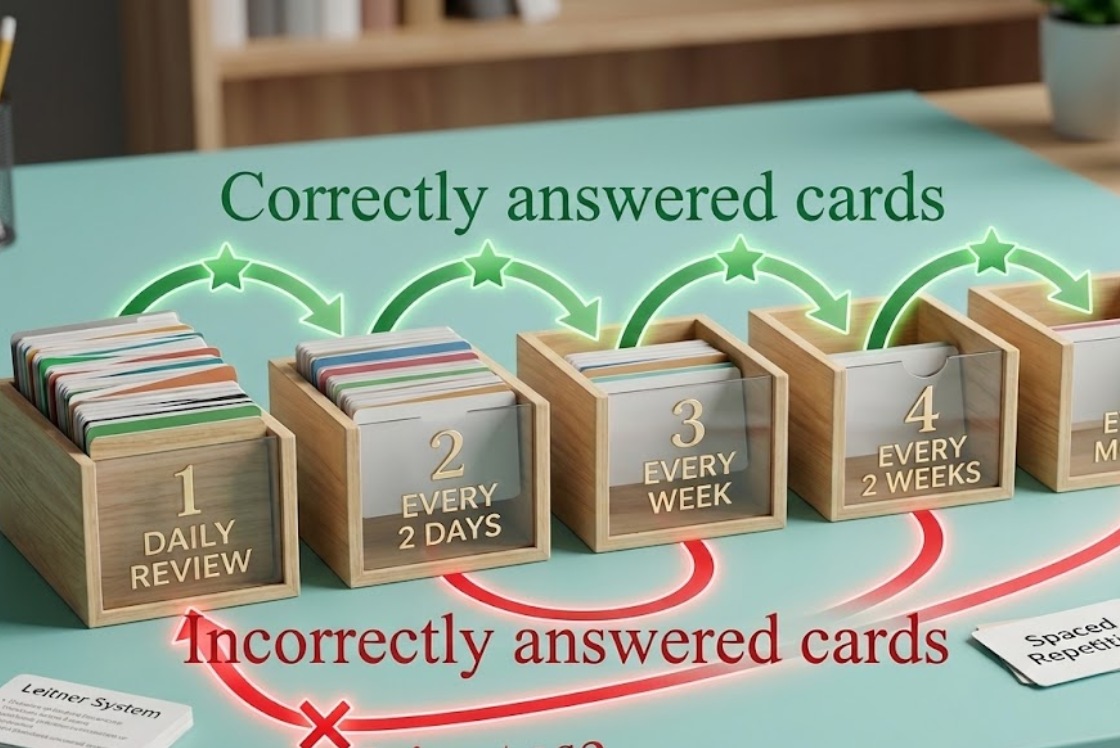
The Leitner System is a structured flashcard study method that uses spaced repetition and active recall to improve long-term memory retention. Students use the system to prioritize difficult material, strengthen recall, and create a more efficient study routine.
Students preparing for cumulative exams often need more than repeated review. The Leitner System provides a structured approach to flashcard study by combining active recall with spaced repetition.
Whether students are preparing for cumulative exams, building language skills, or mastering complex academic terminology, standard rote memorization often falls short. Flashcards, when used conventionally, often lead to passive reading rather than genuine mastery.
By integrating spaced repetition and active recall, the Leitner System transforms simple flashcards into a high-efficiency learning engine designed to beat the forgetting curve and lock facts into your long-term memory.
What Is The Leitner System?
The Leitner System organizes flashcards into review categories based on how consistently a student can recall information.
Developed by German science journalist and author Sebastian Leitner in the 1970s, the Leitner System is a structured study method that uses flashcards and physical (or digital) boxes to manage review intervals.
Instead of reviewing every card in your deck with equal frequency, you move cards between different proficiency levels or “boxes” depending on how well you recall the answer.
Research on memory demonstrates that information becomes harder to recall without reinforcement. Spaced repetition strengthens retention by scheduling review sessions before knowledge is forgotten. By testing yourself right at the point where memory begins to fade, you strengthen neural pathways and maximize long-term retention with minimal effort.
How Do You Set Up The Leitner System And Use It?
Key Facts About The Leitner System
- The Leitner System uses active recall and spaced repetition to improve flashcard efficiency.
- Students review difficult cards more frequently than mastered cards.
- The system helps organize study time around weaker areas.
- Flashcards work best when each card tests one specific concept.
Setting up the Leitner System requires minimal setup, whether you use physical index cards or digital study tools.
An AI-powered flashcard app like Cerebella can simplify setting up the Leitner System and tracking your progress, offering automated features to streamline your study process.
Step 1: Gather Your Materials
Prepare your flashcards with a single prompt or question on the front and a concise, clear answer on the back. Ensure each card tests one specific concept to make active recall unequivocal.
Step 2: Establish Your Boxes
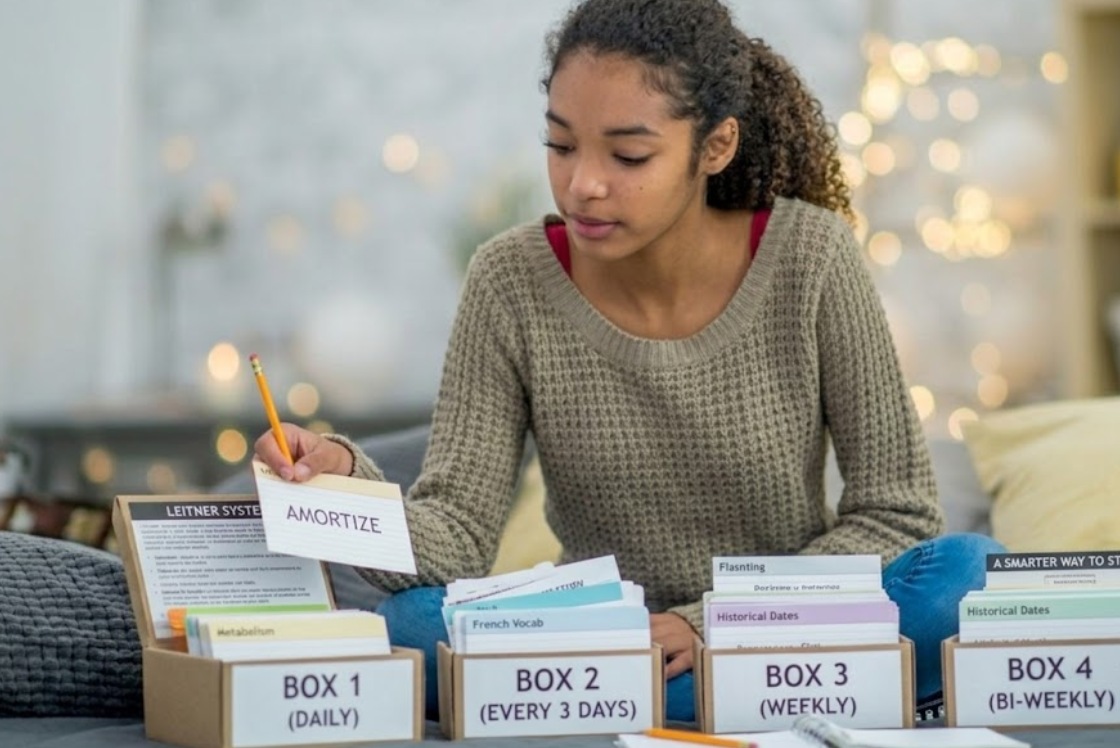
Designate 3 to 5 physical boxes, dividers, or digital folders labeled by proficiency:
|
Category |
Proficiency Level |
Review Schedule |
|
Box 1 |
New or difficult cards |
Review Daily |
|
Box 2 |
Correctly recalled once |
Review Every 2–3 Days |
|
Box 3 |
Correctly recalled twice |
Review Every 5–7 Days |
|
Box 4 |
Correctly recalled three times |
Review Every 10–14 Days |
|
Box 5 |
Consistently mastered |
Review Monthly / Before Exams |
Step 3: Run Your Study Sessions
- Initial Review (Box 1): Test yourself on cards in Box 1.
- If correct: Move the card forward to Box 2.
- If incorrect: Keep the card in Box 1.
- Subsequent Reviews: Review each box according to its assigned schedule.
- Moving Up: Answering a card correctly advances it to the next higher box.
- Demotion / Reset: If you get a card wrong in any box, move it back to Box 1 immediately. This forces immediate re-engagement with unmastered material.
Step 4: Maintain Continuous Flow
Regularly add new cards to Box 1 as your study material expands. As older cards progress to higher boxes, daily study time remains light and manageable despite a growing overall deck.
Why the Leitner System Works: The Science of Active Recall
Active recall requires students to retrieve information from memory instead of simply rereading notes.
The “magic” of the Leitner System lies in two evidence-backed cognitive psychology principles:
- Active Recall: Forcing your brain to retrieve an answer without looking builds stronger synaptic connections than passively reading notes.
- Spaced Repetition: Spacing out review sessions forces memory retrieval to require cognitive effort, which signals to the brain that the information is vital for long-term storage.
By automating your review frequency based on performance, the Leitner System guarantees that 80% of your effort is spent on the 20% of material you find hardest, maximizing total study efficiency.
Key Advantages Over Traditional Flashcard Methods
- Targeted Study Time: Eliminates time wasted repeatedly reviewing facts you already know well.
- Prevents Overconfidence Bias: Prevents the illusion of competence created by flipping through a static deck.
- Durable Long-Term Retention: Builds resilient long-term recall necessary for comprehensive, cumulative exams.
- High Customizability: Easily adapt box counts and schedule intervals to fit your personal learning pace and exam deadlines.

When Students Typically Need Structured Study Systems
Students often seek study strategies when academic workload increases or major exams require long-term preparation.
Common situations include:
- preparing for cumulative finals
- managing AP coursework
- studying for Regents exams
- learning large amounts of vocabulary or terminology
- transitioning into more demanding academic environments
Limitations & Drawbacks to Consider
While effective, the Leitner System has a few caveats:
- Setup Overhead: Managing physical boxes and tracking review intervals across multiple decks requires organizational discipline.
- Initial Familiarity Needed: The system relies on self-testing, so it works best when you already have a foundational understanding of the concept rather than learning raw facts for the very first time.
- Rigid Schedule Demands: Skipping scheduled review sessions can cause cards to pile up, causing friction for inconsistent study habits.
Is the Leitner System Right for You?
Ideal For:
- Cumulative Exam Prep: Pre-med, bar exam, AP/IB, and final exam prep covering extensive material over months.
- Language Acquisition: Vocabulary building, grammar rule memorization, and kanji/alphabets.
- Structured Learners: Students who thrive with systematic routines and visual indicators of progress.
Less Ideal For:
- Last-Minute Cramming: Short-term memorization for a quiz scheduled for the next day.
- Complex Synthesis: Conceptual essays or problem-solving tasks that require critical synthesis rather than fact retrieval.
How Study Systems Support Academic Performance
Structured study systems help students create consistent routines for managing academic workload and long-term retention.
The Leitner System represents one example of academic infrastructure that helps students organize preparation, monitor progress, and improve study efficiency.
Students who need broader academic support may also benefit from structured tutoring focused on subject mastery, assignment systems, and academic performance strategies.
Check Our Our Other Blogs:


Craig Selinger
Latest posts by Craig Selinger (see all)
- What Executive Function Challenges Look Like in High School - July 3, 2026
- Teen Burnout: Causes, Signs & Long-Term Impact - July 1, 2026
- Summer Reading Accelerator for Middle & High School Students - June 13, 2026
No Comments