
 Brooklyn Letters

1139 Prospect Avenue, Brooklyn
-
We would highly recommend Ally! Our son always asks about her, so very thankful to Brooklyn Letters for introducing us.
~ Emily, mom of Brooklyn 2 year old -
Nicole has been an amazing therapist!! She played a tremendous role in our daughter’s speech progress and overall development. She has come such a long way and we are so happy with the therapy she received!
-
I cannot express how grateful and rewarding my experience with Brooklyn Letters has been. Her tutor Ms. Daria is so knowledgeable, amazing, kind and awesome. My daughter has made so much progress in Literacy and Math and it's all … More thanks to Ms. Daria. I know my daughter is sad that she can no longer work with Ms. Daria, as she looked forward to their sessions every week. Thank you again!
-
Excellent services, caring therapists.
-
Christina was absolutely wonderful. She went out of her way to win my son over and it worked. He looked forward to her visits and his speech improved so much under her care. She was super flexible and it’s clear she truly cares. We adore … More Christina and we’re going to miss her. Almost sad he improved so much! She’s simply amazing and we can’t say enough how great she is. I would recommend her services to anyone and everyone, without hesitation. Thank you so much for connecting us with her!
-
We could not be happier with the services Valerie provided! She is very thoughtful and knowledgeable and provided significant guidance to support our daughter's speech development outside of our scheduled sessions. She established … More a great working relationship with her, and she will definitely be missed! Your business model is amazing and it was an absolute pleasure working with Valerie. I've referred your organization and Valerie to the Executive Director of our daughter's school and friends/colleagues who are in need of speech therapy services.
-
We cannot say enough good things about Effie, the ASL teacher, who was so engaged and effective with our 2 year old daughter from the very first session! Effie gladly included our whole family in the sessions! Her expertise and fantastic … More personality gave our daughter a way to communicate that she was so desperately seeking. The coordinators at Brooklyn Letters were so helpful and communicative…I would highly recommend their services!
-
The company is great with outstanding customer service. They keep my horses protected. I have recommended them to other horses trainers as well that are going to get service early next year. Very professional an honest too. Respectfully … More submitted Christopher
-
Ron and Ken did a fantastic job with our security system today. Installed everything very quick. Both of them were very polite and asked us throughout if the installation met our needs. Simply fantastic!
-
I called Cornerstone Protection to get a Security system at a relatives out of state property, within a week it was installed! The installers worked with the client to help understand her new system and she was happy! Our relative said … More they were courteous, professional and patient! I highly recommend Cornerstone Protection for all of your security needs!
-
Had blink cameras; Car was broken into multiple times so I called CornerStone & they were able to install multiple cameras very quickly & for a reasonable price. I am so happy with the app & getting alerts that are not superfluous, … More like they were with Blink. Highly recommend CornerStone & the tech Ronnie.
-
Ron and Ken are great guys to work with.
Both were very knowledgeable and got our system back up and running.
Thanks to both for a job well done... -
Samantha Dalmas was fantastic! We saw her for a feeding therapy evaluation and while she doesn’t think my daughter needs more feeding therapy sessions at this time, but she gave me lots of tips to try. If my daughter's doctors want … More to see more progress at her next appointment, I wouldn’t hesitate to reach out to Samantha again.
-
Amazing assistance provided by Shannon today on my security system. I’m so grateful for your prompt, efficient, professional, and courteous service. Put me down as a customer for life!
-
One of the most painless experiences I've had. They came on time and was over the moon professional with still keeping a level of personability to it. The gentleman also went out of his way to say that my husband and Mines business … More was appreciated. Which is actually rare to be appreciated by such a great company. So thank you and we look forward to continuing services with this company.
-
I am so happy we decided to go with cornerstone. They were quick and efficient. Shannon and the installer we very friendly. We got a lot of equipment and it was still within our budget. 10/10 would definitely recommend! Thank you
-
Love the customer service and Shanon and his team go above and beyond for my restaurant. Couldn't of asked for a better security system and level of service that his team provides.
-
I have been using Cornerstone Protection service for over 5 years and I'm really happy with the service and state-of-the-art equipments and it's futures are so much in advance and friendly, I highly recommend Cornerstone Protection … More Service any and all business that need a security protection days and nights specially after business hours(Cornerstone Protection is perfect solution for your business). Owner of Cornerstone Protection is proactive with their customers and their equipments. Good experienced with Cornerstone Protection!!!
Kanu Patel -
We had a very positive experience with Alissa as a tutor for our pod of 5th grade boys from January - June 2020. She cared a lot about the boys and worked hard to create meaningful activities for them. The pod experience was invaluable … More for all of our families during a difficult year and we were so grateful to have found this partnership! We also want to appreciate Craig for helping to match us with a tutor on very short notice after we had cycled through a few folks who were not able to see the commitment through. Thanks for sticking with us!
-
Dusty was the exact person we needed to help our child finish out the school year. So grateful to him for the way he steadily encouraged her and helped her stay on track and organized. He is flexible, responsive to our needs/schedule as … More a family, and a delight to be with. We are also thankful that Craig at Themba Tutors really "gets it" and partnered us with such a wonderful tutor who was a great fit for our girl.
-
My child worked with Gillian D virtually for math enrichment. She is an excellent teacher. She took time to understand my child's specific learning style and provided tools that would be engaging. She was kind and empathetic- really … More made it her goal to connect with my child and build trust and rapport. My child started the school year with confidence and without the typically "brain-drain" that occurs over the summer, thanks to Gillian.
-
I am going into my second year as a Themba tutor. I have met so many great individuals while working for this company. Craig and the rest of the Themba team do such an excellent job picking and choosing Themba tutors that suit each client's … More individual needs! I look forward to meeting new tutors and clients in the 2021-2022 school year!
-
Our son started in a new high school, 100% remote, and was really struggling with Latin and Physics. I found Themba Tudors online and had an initial call with Craig, who was very knowledgeable, responsive, and found 2 amazing tutors for … More us. Both the Latin and the physics tutors were fantastic, connected with my son really well and helped him go from 'failing' grade to 'honors'! I will for sure continue using (and recommending!) Themba Tutors. Thank you, C, K, and W!
-
Brian is a fantastic executive functioning coach. Super helpful, flexible with hours, and tailored the experience to our needs.
-
Giulia Mercuri is a great Italian tutor! She was very responsive and accessible. Giulia put a ton of effort into preparing for each session and really helped our son with test preparation and projects. We are grateful that she was able … More to help, especially since our son did not receive any live teaching during COVID. We are happy that she was referred to us!
-
As an adult student diagnosed with a learning disability during grad school, I knew I needed help dealing with my Master's program's demanding workload. I was seriously considering dropping out when I was referred to Themba Tutors. … More I was paired up with a wonderful tutor, Julie, who was a total lifesaver. I learned many techniques that I can utilize in the future as I embark on the next phase of my career.
I can wholeheartedly say after working with Themba for two years that I would not have finished my program without this organization. And I am so thankful I selected them. -
We were introduced to a wonderful tutor: Mcedwyn. He and our son, a freshman in college, worked well together. As a result, our son’s grades significantly improved. The tutor taught our son subject content and various methods to effectively … More study for quizzes and exams. Our son was also taught time management and organization. My son’s experience with the tutor made the first year of college a less intimidating experience.
-
We have been with our tutor, Cailin Schiller, for two years, from 5th - 7th grade. She started as an executive functioning tutor with my daughter. From the start, she demonstrated a depth of expertise and a selective use of techniques skillfully … More adapted to my daughter’s ADHD and Math disability. Cailin made Math accessible and understandable to her in a way that even her teachers had not been able to do. She differentiated reading, writing and math tasks and assignments to tailor them to my daughter’s unique learning differences. Not only did it have an effect on her grades and her work efficiency, but she finally could do her work with less anxiety. Even my daughter’s teachers used Cailin’s guidance to modify their work with her. But most importantly, she became my daughter’s favorite resource. I can’t say how invaluable Cailin has been to my daughter’s progress and well-being. I’d recommend her a million times over. She is a gem.
-
Victoria is a superb tutor. She helped my high school age daughter with her writing. Victoria's skills as a tutor, as well as her sense of humor and her engaging personality went a long way with my daughter.
-
Themba Tutors provided a leaning specialist that was a perfect fit for my daughter. I told them what we were looking for and they delivered. Our tutor is responsive and flexible and makes it easy for my daughter to reach out to her own … More her own, which gives her an added sense of responsibility over her learning. As a therapist myself, I now regularly recommend Themba to my patients. A much needed and well provided service to the community!!
-
The tutors at Themba are fantastic! Caitlyn McNeill helped our son academically, but also with getting organized in every subject, which he so desperately needed. She offered great advice and useful strategies that helped our son become … More a more successful student. We are using Themba tutors again this year for our daughter. We're so happy to have been referred to them!
-
I'm so glad we were referred to Themba Tutors. After a great initial conversation to learn our needs, we were connected with an excellent tutor, Felicia, who is helping our high school daughter learn better organizational and executive … More skills. Highly recommended.
-
We had a wonderful experience with our tutor Micaela. She helped our son not only academically but at every level. We will be forever grateful to have her in our lives.
-
The tutors at Themba are fantastic! Caitlyn McNeill helped our son academically, but also with getting organized in every subject, which he so desperately needed. She offered great advice and useful strategies that helped our son become … More a more successful student. We are using Themba tutors again this year for our daughter. We're so happy to have been referred to them!
-
Paul Smith at Themba has been an exceptional tutor for my son, both in terms of teaching the subject matter and teaching how best to approach the process of learning math and executing assignments. We feel very fortunate to be working with … More Paul.
-
We were very lucky to have found Edwouine Swift, my son's therapist through Themba Tutors. Thomas is 12 years old, and it is extremely difficult to get him to write. Edwouine just works her magic with him, he adores her and is so … More eager to follow her guidance. I have no doubt she will be a positive driving force in his academic future.






























Remote Executive Function & ADHD Coaching for College Athletes
Train Your Brain Like You Train Your Sport
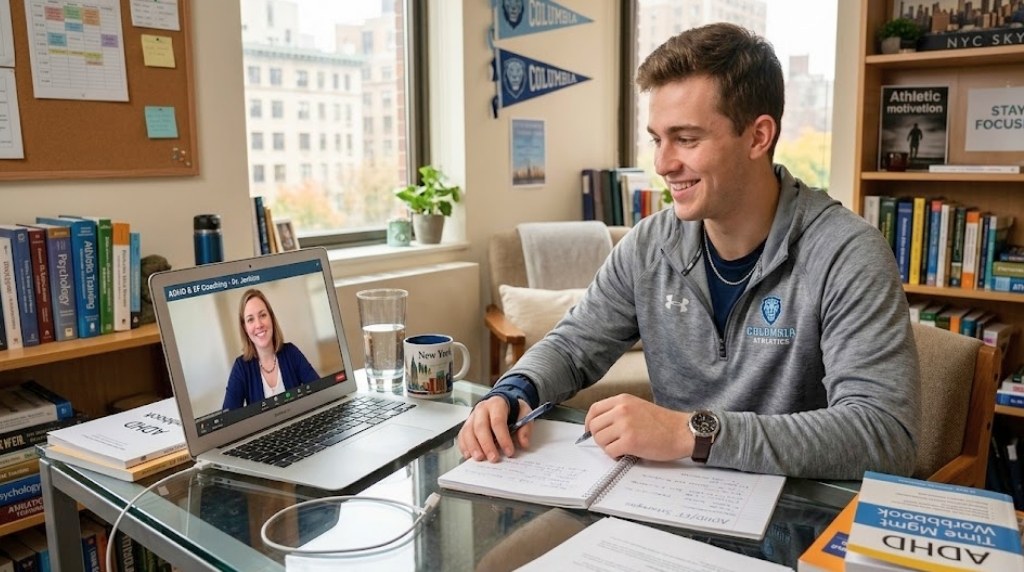
Remote College Athlete ADHD Executive Function Coaching
Build an academic system that travels with your season.
College athletes train to improve performance. They plan, practice, maintain focus, respond to mistakes, adjust strategies, and prepare for competition. These same skills can help them manage college coursework, long-term assignments, travel schedules, and everyday responsibilities.
Themba Tutors provides personalized remote executive function and ADHD coaching for college athletes who want to transfer their athletic strengths into academics and independent living. Instead of simply telling students to work harder or become more organized, we help them identify where their routines break down, develop practical strategies, and practice using those strategies in real situations.
The guiding principle is simple: Train your brain like you train your sport.
Whether you are balancing morning workouts, afternoon classes, evening practices, away competitions, or a demanding exam schedule, coaching helps you build a repeatable system for planning, starting, focusing, remembering, regulating emotions, and following through.
Remote coaching is available to college athletes in the NYC metro area, throughout the United States, and internationally, subject to scheduling and coach availability.
For additional support and information, explore our NYC student-athlete ADHD and executive function coaching resources to learn more about personalized strategies for balancing academics and athletics.
The College-Athlete Challenge: High Performance Requires More Than Talent
Navigating College With ADHD and Executive Function Challenges
College athletes operate in two demanding environments. Athletics may provide coaches, scheduled practices, performance feedback, and established routines. College academics often require students to create their own structure, manage competing deadlines, and recognize problems before they become urgent.
A student may demonstrate excellent discipline during training yet postpone a research paper, forget an assignment, underestimate how long studying will take, or struggle to recover after a disappointing grade.
These difficulties do not necessarily reflect a lack of motivation or ability. Executive functioning involves the mental skills used to plan, organize, initiate tasks, manage attention, remember responsibilities, regulate emotions, and adapt to changing circumstances.
For students with ADHD, these demands may be particularly challenging. Other neurodivergent students may also benefit from strategies tailored to their individual needs.
Our approach connects athletic performance principles with executive functioning and academic performance. We help students recognize what already works in their sport and transfer those skills to coursework, college life, and future professional responsibilities.
Common Challenges We Help College Athletes Address
- Task initiation: Getting started on assignments without waiting for the pressure of an approaching deadline.
- Time management: Estimating how long work will take and planning around classes, training, travel, and recovery.
- Organization: Keeping track of syllabi, learning platforms, emails, assignments, and responsibilities.
- Study efficiency: Replacing passive rereading with active practice and feedback.
- Working memory: Using external systems to remember instructions, deadlines, and next steps.
- Emotional regulation: Recovering after a poor grade, missed deadline, or disappointing performance.
- Self-advocacy: Communicating with professors, advisors, and campus support staff.
- Independent living: Managing appointments, meals, laundry, sleep routines, and other responsibilities without constant parental reminders.
Coaching begins with the student’s own goals. The objective is not to create a perfect schedule but to build a practical performance system the student can increasingly manage independently.
Supporting Neurodivergent Athletes Beyond ADHD
Athletes have different strengths, experiences, and support needs. Some students may also be navigating autism-related differences while participating in sports. Understanding individual needs and reducing barriers can help create more supportive athletic experiences.
Explore our article on athletes with autism and breaking barriers in sports for additional perspectives on neurodiversity and participation in athletics.
Build a High-Performance Loop
Our coaching helps students practice a consistent sequence:
- Identify the miss. What is preventing progress?
- Choose the play. What specific strategy could help?
- Use it in real life. When will the student apply it?
- Review the result. What worked, and what needs adjustment?
A student might discover that studying immediately after an early class works better than waiting until a late practice ends. Another might learn that starting a paper with a ten-minute outline is more effective than setting aside three hours to “work on it.”
The goal is to help students make informed adjustments based on experience, not simply repeat a strategy that is not working.
Plan Your Semester Around Classes, Competition, and Travel

Lock → Locate → Backplan
College athletes need a planning system that accounts for the entire semester, not just the next assignment.
Our Lock → Locate → Backplan approach helps students organize their academic and athletic commitments.
- Lock: Record fixed commitments first, including classes, practices, games, tournaments, travel, and appointments.
- Locate: Identify upcoming exams, papers, projects, and other responsibilities.
- Backplan: Work backward from each deadline to determine when preparation must begin and which smaller steps belong on the calendar.
For example, a student with an away competition on Sunday might need to complete research before leaving campus, draft part of a paper during an earlier study block, and reserve time to revise it after returning.
The point is to plan around reality rather than assume that every open hour will be available for productive work.
Make Travel and Recovery Part of the Plan
Travel time is not automatically productive study time. Transportation, fatigue, internet access, team obligations, and changing schedules all affect what is realistic.
Before an away competition, students can practice:
- Reviewing deadlines that fall during or immediately after travel.
- Completing work that requires a quiet environment before departure.
- Downloading readings and organizing necessary materials.
- Identifying short tasks that can reasonably fit into available time.
- Communicating with professors about foreseeable conflicts when appropriate.
- Protecting sleep and recovery rather than filling every available hour with work.
The objective is to build a flexible system that survives schedule changes.
Balance Performance, Sleep, and Daily Responsibilities
Strong performance depends on more than completing assignments. College athletes also need routines that support sleep, recovery, meals, personal responsibilities, and relationships.
Coaching can help students recognize when an overloaded schedule is unrealistic, prioritize essential commitments, and develop routines that make the next day easier to manage.
Start Earlier With the 10-Minute Start
Knowing what needs to be done does not always make it easy to begin. Large assignments can feel overwhelming when the first action is unclear.
The 10-Minute Start turns a vague goal into a specific, manageable action.
Instead of writing “work on research paper” in a planner, a student might:
- Open the assignment instructions and identify the requirements.
- Write down three possible arguments.
- Find one credible source.
- Create a short outline.
- Draft the opening paragraph.
The student commits to beginning with one clearly defined action for ten minutes. Once started, the student can decide whether to continue, take a planned break, or schedule the next work block.
The strategy is not a substitute for completing the assignment. It is a way to overcome the initial resistance that can prevent progress.
Our coaches help students connect that first step to a larger plan, including intermediate deadlines, realistic work sessions, and follow-up.
Study Like an Athlete: Find It → Train It → Test It
Spending more time studying does not always produce better results. College athletes often have limited study windows, making efficient preparation especially important.
Our approach encourages students to identify what they need to learn, practice the difficult material, and check whether they can use it independently.
- Find it: Identify concepts, questions, or problems you cannot yet explain or solve confidently.
- Train it: Practice those specific weaknesses using appropriate study methods.
- Test it: Retrieve information or solve problems without immediately consulting notes or answers.
Depending on the course, this may involve retrieval practice, practice problems, self-quizzing, explaining concepts from memory, or reviewing errors.
For example, a student preparing for a biology exam might answer practice questions without notes, identify concepts that remain unclear, review those areas, and test them again later.
This process is more targeted than repeatedly rereading an entire chapter without checking what has been learned.
Executive function coaching helps students plan and maintain effective study routines. Subject tutoring can provide additional instruction when a student needs help understanding the course material itself.
Build Organization Systems That Reduce Memory Demands

Keep Assignments, Deadlines, and Next Steps Accessible
Students should not have to rely on memory alone to manage every responsibility.
A practical organization system may include:
- One dependable place to record assignments and responsibilities.
- A calendar that includes work-start dates as well as final deadlines.
- Reminders for recurring academic and athletic commitments.
- Checklists for travel preparation and regular responsibilities.
- Scheduled reviews of syllabi, course platforms, and email.
- Written notes and follow-up actions after professor or advising meetings.
The goal is not to accumulate more apps or create an elaborate planner. It is to establish a small number of reliable habits that the student can maintain during both ordinary and demanding weeks.
Practice Prioritization When Everything Feels Urgent
College athletes sometimes face several competing demands at once: an upcoming exam, a paper due after travel, a team commitment, and personal responsibilities.
Coaching helps students evaluate deadlines, importance, preparation time, and available energy. They learn to distinguish what must happen now from what can be scheduled later.
When the week changes, they practice rebuilding the plan instead of abandoning it entirely.
Recover From Setbacks: Acknowledge → Reset → Next
Athletes cannot allow one missed shot, poor race, or disappointing performance to determine everything that follows. The same principle applies to academics.
A low exam grade, missed assignment, or disrupted study schedule can trigger frustration and avoidance. Without a recovery strategy, one setback may interfere with several days of work.
Our Acknowledge → Reset → Next approach helps students respond constructively.
- Acknowledge: Identify what happened and recognize the emotional response without allowing it to dictate the next decision.
- Reset: Take a brief pause and use a practiced strategy to regain perspective.
- Next: Identify the next useful action.
That action might be reviewing exam errors, asking a professor for clarification, checking the next deadline, adjusting a study plan, or completing one manageable task.
A disappointing result becomes information that can guide the next attempt rather than a reason to abandon the rest of the week.
Develop Self-Advocacy With Professors and Campus Staff
College athletes are expected to take increasing responsibility for their academic needs. They may need to clarify an assignment, ask questions during office hours, discuss a foreseeable scheduling conflict, or follow up on academic support.
Coaching helps students practice those skills.
Depending on their needs, students may work on:
- Preparing specific questions before meeting a professor.
- Explaining what they have already tried and where they remain stuck.
- Drafting a clear, respectful email.
- Preparing for academic advising or accessibility appointments.
- Recording agreed-upon next steps and scheduling follow-up.
- Identifying appropriate campus resources before a problem becomes urgent.
The objective is not for someone else to manage college on the student’s behalf. It is to help the student become more confident and effective at seeking information, communicating needs, and following through.
Any direct coordination with parents, professors, advisors, or other support people is discussed with the student and follows agreed consent and privacy boundaries.
Use AI as a Digital Caddy, Not a Replacement for Thinking
When used appropriately, AI tools such as ChatGPT or Gemini can support executive functioning by helping students plan, organize, practice, and reflect.
Students might use AI to:
- Turn a busy week into a realistic draft schedule.
- Break a large project into smaller tasks.
- Identify a manageable first step.
- Generate practice questions for self-quizzing.
- Check whether a study plan leaves enough time for preparation.
- Reflect on why a strategy did or did not work.
For example, a student might ask an AI tool to quiz them one question at a time on material they have already studied, then identify topics that require further review.
The guiding principle is simple: AI can help you plan, organize, practice, and reflect—but it should not take the shot for you.
Students remain responsible for checking accuracy, making decisions, understanding the material, and completing their own work. AI use must follow course and institutional policies, including applicable rules on academic integrity and permitted assistance.
TESTIMONIALS
Brian is a fantastic executive functioning coach. Super helpful, flexible with hours, and tailored the experience to our needs.
-Eric Fingerman
My first session went really well. I think Giulia has been a tremendous help. I have been making good progress with regard to my study habits and my executive functioning.
-C.B.
Jacob is a great tutor who worked with my son over the course of two years providing much-needed guidance on his executive functioning and organizational skills and overcoming a variety of challenges posed by my son’s learning disabilities. His patience in learning about my son’s disabilities provided him with insight into developing the best strategies possible to overcome my son’s multifaceted obstacles. He built up a great rapport with my son and I would recommend him highly to other parents seeking specialized tutoring services.
-JB & AK
We are delighted by Chris’s work with M! He has done a great job of helping him focus and prioritize, and offering up strategies to cope with difficult/challenging academic situations. He is also a lovely guy. He and M have forged an authentic bond, and M actually enjoys their sessions. Big thumbs up!
S & D
At Themba Tutors, we take the time to help students/clients understand their strengths and progress in areas where they need to improve. We offer personalized tools for each of our clients to help them become more aware of their individual needs as they work towards short-term goals. Improving these skills will benefit our students’/clients’ long-term plans.


ALEX F.
M.S Occupational Therapy

MADDY
Doctoral Candidate in Clinical Psychology

CAMERON
Master’s Degree in Psychology

REBECCA A.
Master’s in Social Work, BA in Neuroscience and Music

CHARLES
Ph.D Education Leadership

JOYA K.
Master’s in Educational Psychology
Focus on One Meaningful Improvement at a Time
Trying to overhaul every habit at once can create another source of overwhelm. Our coaching approach emphasizes small, practical performance experiments.
Students can use the following framework:
My Miss → My Play → When I’ll Use It
For example:
- My Miss: I postpone studying until after evening practice, when I am too tired to concentrate.
- My Play: I schedule a short retrieval-practice session between classes.
- When I’ll Use It: Tuesday and Thursday before afternoon training.
- My Review: Did I follow through? What helped or interfered? What should I adjust?
The student then evaluates the result and decides whether to continue, refine, or replace the strategy.
Over time, these small experiments help students develop self-awareness, make better decisions, and take greater ownership of their academic and personal responsibilities.
Support for Neurodivergent College Athletes
College athletes have different strengths, challenges, and support needs. Some students with ADHD may struggle with task initiation, attention regulation, time awareness, or working memory. Other neurodivergent students may need different approaches to organization, communication, transitions, or managing competing demands.
Our coaching is individualized rather than based on the assumption that every athlete needs the same system.
Explore our resources on executive function skills and ADHD to learn more about the skills and challenges that may affect academic performance.
Coaching can complement appropriate campus accommodations, academic resources, and clinical care. It does not replace medical or mental health treatment.
Academic Planning and Athletic Eligibility Responsibilities
Themba Tutors can help college athletes organize academic responsibilities, track deadlines, prepare questions, and follow through on plans.
However, an institution’s designated athletic compliance staff must confirm the eligibility requirements that apply to a student. Executive function coaching does not determine eligibility or guarantee continued eligibility.
When eligibility-related concerns affect a student’s schedule, coaching can help incorporate confirmed requirements and deadlines into a realistic academic plan.
How Remote College-Athlete Executive Function Coaching Works
Our remote model provides one-on-one support from a dorm, home, or another suitable location with reliable internet access.
Sessions are connected to the student’s actual responsibilities. Depending on current priorities, a session might involve reviewing upcoming deadlines, mapping a demanding week, breaking down a paper, practicing an active study strategy, preparing a message to a professor, or evaluating why a previous plan did not work.
Plan → Perform → Reflect → Adjust
Students and coaches identify a challenge, choose a strategy, apply it between sessions, and review the outcome.
The student remains actively involved in choosing goals and evaluating progress. Strategies are adjusted as academic workloads, competition schedules, travel demands, and personal responsibilities change.
The ultimate aim is to develop a system that the student can increasingly use without depending on a coach or parent to make every decision.
Complementing Campus Academic Support
Colleges may offer academic advising, tutoring, accessibility services, learning support, and resources specifically for student-athletes.
Private executive function coaching can complement these services by helping students prepare for appointments, organize recommendations, schedule next steps, and follow through between meetings.
For students who also need direct academic instruction, executive function coaching for college students and subject-specific tutoring may provide additional avenues for support.
Is Themba Tutors the Right Fit for You?
Remote college-athlete executive function coaching may be appropriate if you:
- Have ADHD or experience challenges with executive functioning.
- Perform well in structured athletic settings but struggle to manage independent academic work.
- Have difficulty starting assignments or managing long-term projects.
- Need a better way to combine course deadlines, practices, competitions, and travel.
- Find that disrupted routines affect your studying or sleep.
- Want to develop more effective study strategies.
- Need practice communicating with professors or campus support staff.
- Want to manage daily responsibilities with greater independence.
- Are ready to test practical strategies and evaluate what works.
A consultation helps us understand your needs and discuss whether executive function coaching, academic tutoring, or another form of support may be appropriate.
Why College Athletes Choose Themba Tutors
- Planning connected to the college calendar. We account for semesters, major assignments, travel, and recurring commitments.
- Personalized one-on-one support. Strategies reflect your particular needs and goals.
- Remote access. Meet from a suitable location, with scheduling based on availability.
- Practical tools. Apply planning and task initiation strategies to current work.
- Self-advocacy practice. Prepare to ask questions and use campus resources.
- Support for daily independence. Address responsibilities beyond coursework when relevant.
- Regular reflection. Review what happened and adjust the system.
- Thoughtful matching. Free remote meet-and-greets help you explore the coaching relationship.
Frequently Asked Questions
1. How does executive function coaching help college athletes?
It provides support for managing coursework, study preparation, travel, communication, and daily responsibilities. Sessions focus on practical systems the student can use increasingly independently.
2. Do I need an ADHD diagnosis?
No formal diagnosis is required to contact us about executive function difficulties. We will discuss your challenges and whether coaching is appropriate.
3. How do remote sessions fit around an athletic schedule?
Share your recurring commitments and preferred times. We will check coach availability and discuss a workable arrangement. Known travel dates can be included in planning.
4. Can coaching help me maintain athletic eligibility?
Coaching can support academic planning and follow-through. Your institution’s designated staff must confirm applicable requirements and eligibility status; Themba Tutors does not guarantee eligibility.
5. What if my college already offers academic support?
Coaching can complement existing services by helping you prepare for appointments, use recommendations, and follow through between meetings.
6. Is coaching the same as subject tutoring?
Coaching focuses on managing the learning process. Tutoring focuses on understanding and practicing academic content. Some students need both.
7. Can my parents participate?
Your goals and ownership guide the work. Parent participation or progress sharing is discussed with you and follows agreed consent and privacy arrangements.
8. How long should I work with a coach?
The appropriate duration depends on your goals, needs, and progress. The consultation is an opportunity to discuss a starting arrangement, with the plan reviewed over time.
9. Do you support students across different sports and competition levels?
Tell us about your sport, level of competition, and schedule. We will assess your needs and suitable coaching options rather than assuming every athlete requires the same approach.
10. How is this different from coaching for younger athletes?
College-athlete coaching emphasizes semester planning, campus communication, independent study, travel preparation, and personal responsibility. Middle and high school coaching includes more age-appropriate parent support and school-to-home routines.
Build a More Manageable College Week
The next step does not have to be a complete overhaul of your routine.
Start with the responsibility that is causing the most difficulty right now: beginning an assignment, organizing deadlines, preparing for travel, studying effectively, recovering after a setback, or communicating with a professor.
Themba Tutors can help you identify the challenge, choose a practical strategy, and test it in your actual college schedule.
Focus. Plan. Start. Remember. Regulate. Reflect. Adjust.
The goal is not simply better grades or a more organized planner. It is to help you develop the self-management skills that support performance across academics, athletics, and everyday life.
Ultimately, strong student-athletes learn to manage the next assignment, the next practice, the next test, the next competition, and the next decision.
What would a high performer do next?
Schedule a free consultation to discuss your goals, schedule, and coaching options. Each potential coach offers a free 15-minute remote meet-and-greet so you can explore whether the relationship feels like a good fit.
Not ready to fill out the form yet? We’re here to make this easy.
📞 (917) 382-8641 | 📲 (917) 382-8641 | ✉ info@thembatutors.com
Every coach offers a free 15-minute remote meet-and-greet, so you can get to know them and see if it feels like the right fit. We’re very responsive and easy to communicate with throughout the process. From there, we’ll thoughtfully match you with one or more of our coaches.