
 Brooklyn Letters

1139 Prospect Avenue, Brooklyn
-
We would highly recommend Ally! Our son always asks about her, so very thankful to Brooklyn Letters for introducing us.
~ Emily, mom of Brooklyn 2 year old -
Nicole has been an amazing therapist!! She played a tremendous role in our daughter’s speech progress and overall development. She has come such a long way and we are so happy with the therapy she received!
-
I cannot express how grateful and rewarding my experience with Brooklyn Letters has been. Her tutor Ms. Daria is so knowledgeable, amazing, kind and awesome. My daughter has made so much progress in Literacy and Math and it's all … More thanks to Ms. Daria. I know my daughter is sad that she can no longer work with Ms. Daria, as she looked forward to their sessions every week. Thank you again!
-
Excellent services, caring therapists.
-
Christina was absolutely wonderful. She went out of her way to win my son over and it worked. He looked forward to her visits and his speech improved so much under her care. She was super flexible and it’s clear she truly cares. We adore … More Christina and we’re going to miss her. Almost sad he improved so much! She’s simply amazing and we can’t say enough how great she is. I would recommend her services to anyone and everyone, without hesitation. Thank you so much for connecting us with her!
-
We could not be happier with the services Valerie provided! She is very thoughtful and knowledgeable and provided significant guidance to support our daughter's speech development outside of our scheduled sessions. She established … More a great working relationship with her, and she will definitely be missed! Your business model is amazing and it was an absolute pleasure working with Valerie. I've referred your organization and Valerie to the Executive Director of our daughter's school and friends/colleagues who are in need of speech therapy services.
-
We cannot say enough good things about Effie, the ASL teacher, who was so engaged and effective with our 2 year old daughter from the very first session! Effie gladly included our whole family in the sessions! Her expertise and fantastic … More personality gave our daughter a way to communicate that she was so desperately seeking. The coordinators at Brooklyn Letters were so helpful and communicative…I would highly recommend their services!
-
The company is great with outstanding customer service. They keep my horses protected. I have recommended them to other horses trainers as well that are going to get service early next year. Very professional an honest too. Respectfully … More submitted Christopher
-
Ron and Ken did a fantastic job with our security system today. Installed everything very quick. Both of them were very polite and asked us throughout if the installation met our needs. Simply fantastic!
-
I called Cornerstone Protection to get a Security system at a relatives out of state property, within a week it was installed! The installers worked with the client to help understand her new system and she was happy! Our relative said … More they were courteous, professional and patient! I highly recommend Cornerstone Protection for all of your security needs!
-
Had blink cameras; Car was broken into multiple times so I called CornerStone & they were able to install multiple cameras very quickly & for a reasonable price. I am so happy with the app & getting alerts that are not superfluous, … More like they were with Blink. Highly recommend CornerStone & the tech Ronnie.
-
Ron and Ken are great guys to work with.
Both were very knowledgeable and got our system back up and running.
Thanks to both for a job well done... -
Samantha Dalmas was fantastic! We saw her for a feeding therapy evaluation and while she doesn’t think my daughter needs more feeding therapy sessions at this time, but she gave me lots of tips to try. If my daughter's doctors want … More to see more progress at her next appointment, I wouldn’t hesitate to reach out to Samantha again.
-
Amazing assistance provided by Shannon today on my security system. I’m so grateful for your prompt, efficient, professional, and courteous service. Put me down as a customer for life!
-
One of the most painless experiences I've had. They came on time and was over the moon professional with still keeping a level of personability to it. The gentleman also went out of his way to say that my husband and Mines business … More was appreciated. Which is actually rare to be appreciated by such a great company. So thank you and we look forward to continuing services with this company.
-
I am so happy we decided to go with cornerstone. They were quick and efficient. Shannon and the installer we very friendly. We got a lot of equipment and it was still within our budget. 10/10 would definitely recommend! Thank you
-
Love the customer service and Shanon and his team go above and beyond for my restaurant. Couldn't of asked for a better security system and level of service that his team provides.
-
I have been using Cornerstone Protection service for over 5 years and I'm really happy with the service and state-of-the-art equipments and it's futures are so much in advance and friendly, I highly recommend Cornerstone Protection … More Service any and all business that need a security protection days and nights specially after business hours(Cornerstone Protection is perfect solution for your business). Owner of Cornerstone Protection is proactive with their customers and their equipments. Good experienced with Cornerstone Protection!!!
Kanu Patel -
We had a very positive experience with Alissa as a tutor for our pod of 5th grade boys from January - June 2020. She cared a lot about the boys and worked hard to create meaningful activities for them. The pod experience was invaluable … More for all of our families during a difficult year and we were so grateful to have found this partnership! We also want to appreciate Craig for helping to match us with a tutor on very short notice after we had cycled through a few folks who were not able to see the commitment through. Thanks for sticking with us!
-
Dusty was the exact person we needed to help our child finish out the school year. So grateful to him for the way he steadily encouraged her and helped her stay on track and organized. He is flexible, responsive to our needs/schedule as … More a family, and a delight to be with. We are also thankful that Craig at Themba Tutors really "gets it" and partnered us with such a wonderful tutor who was a great fit for our girl.
-
My child worked with Gillian D virtually for math enrichment. She is an excellent teacher. She took time to understand my child's specific learning style and provided tools that would be engaging. She was kind and empathetic- really … More made it her goal to connect with my child and build trust and rapport. My child started the school year with confidence and without the typically "brain-drain" that occurs over the summer, thanks to Gillian.
-
I am going into my second year as a Themba tutor. I have met so many great individuals while working for this company. Craig and the rest of the Themba team do such an excellent job picking and choosing Themba tutors that suit each client's … More individual needs! I look forward to meeting new tutors and clients in the 2021-2022 school year!
-
Our son started in a new high school, 100% remote, and was really struggling with Latin and Physics. I found Themba Tudors online and had an initial call with Craig, who was very knowledgeable, responsive, and found 2 amazing tutors for … More us. Both the Latin and the physics tutors were fantastic, connected with my son really well and helped him go from 'failing' grade to 'honors'! I will for sure continue using (and recommending!) Themba Tutors. Thank you, C, K, and W!
-
Brian is a fantastic executive functioning coach. Super helpful, flexible with hours, and tailored the experience to our needs.
-
Giulia Mercuri is a great Italian tutor! She was very responsive and accessible. Giulia put a ton of effort into preparing for each session and really helped our son with test preparation and projects. We are grateful that she was able … More to help, especially since our son did not receive any live teaching during COVID. We are happy that she was referred to us!
-
As an adult student diagnosed with a learning disability during grad school, I knew I needed help dealing with my Master's program's demanding workload. I was seriously considering dropping out when I was referred to Themba Tutors. … More I was paired up with a wonderful tutor, Julie, who was a total lifesaver. I learned many techniques that I can utilize in the future as I embark on the next phase of my career.
I can wholeheartedly say after working with Themba for two years that I would not have finished my program without this organization. And I am so thankful I selected them. -
We were introduced to a wonderful tutor: Mcedwyn. He and our son, a freshman in college, worked well together. As a result, our son’s grades significantly improved. The tutor taught our son subject content and various methods to effectively … More study for quizzes and exams. Our son was also taught time management and organization. My son’s experience with the tutor made the first year of college a less intimidating experience.
-
We have been with our tutor, Cailin Schiller, for two years, from 5th - 7th grade. She started as an executive functioning tutor with my daughter. From the start, she demonstrated a depth of expertise and a selective use of techniques skillfully … More adapted to my daughter’s ADHD and Math disability. Cailin made Math accessible and understandable to her in a way that even her teachers had not been able to do. She differentiated reading, writing and math tasks and assignments to tailor them to my daughter’s unique learning differences. Not only did it have an effect on her grades and her work efficiency, but she finally could do her work with less anxiety. Even my daughter’s teachers used Cailin’s guidance to modify their work with her. But most importantly, she became my daughter’s favorite resource. I can’t say how invaluable Cailin has been to my daughter’s progress and well-being. I’d recommend her a million times over. She is a gem.
-
Victoria is a superb tutor. She helped my high school age daughter with her writing. Victoria's skills as a tutor, as well as her sense of humor and her engaging personality went a long way with my daughter.
-
Themba Tutors provided a leaning specialist that was a perfect fit for my daughter. I told them what we were looking for and they delivered. Our tutor is responsive and flexible and makes it easy for my daughter to reach out to her own … More her own, which gives her an added sense of responsibility over her learning. As a therapist myself, I now regularly recommend Themba to my patients. A much needed and well provided service to the community!!
-
The tutors at Themba are fantastic! Caitlyn McNeill helped our son academically, but also with getting organized in every subject, which he so desperately needed. She offered great advice and useful strategies that helped our son become … More a more successful student. We are using Themba tutors again this year for our daughter. We're so happy to have been referred to them!
-
I'm so glad we were referred to Themba Tutors. After a great initial conversation to learn our needs, we were connected with an excellent tutor, Felicia, who is helping our high school daughter learn better organizational and executive … More skills. Highly recommended.
-
We had a wonderful experience with our tutor Micaela. She helped our son not only academically but at every level. We will be forever grateful to have her in our lives.
-
The tutors at Themba are fantastic! Caitlyn McNeill helped our son academically, but also with getting organized in every subject, which he so desperately needed. She offered great advice and useful strategies that helped our son become … More a more successful student. We are using Themba tutors again this year for our daughter. We're so happy to have been referred to them!
-
Paul Smith at Themba has been an exceptional tutor for my son, both in terms of teaching the subject matter and teaching how best to approach the process of learning math and executing assignments. We feel very fortunate to be working with … More Paul.
-
We were very lucky to have found Edwouine Swift, my son's therapist through Themba Tutors. Thomas is 12 years old, and it is extremely difficult to get him to write. Edwouine just works her magic with him, he adores her and is so … More eager to follow her guidance. I have no doubt she will be a positive driving force in his academic future.






























CHEMISTRY TUTOR IN NYC

SCHOOLS OUR STUDENTS ATTENDED
Themba Tutors provides individualized chemistry tutoring for students throughout New York City. Students can receive support with standard chemistry, honors chemistry, New York State Regents-level chemistry, and AP Chemistry. Our private tutors can also support selected college-level coursework, depending on the student’s curriculum and the tutor’s subject expertise.
Chemistry combines conceptual understanding, mathematical reasoning, laboratory analysis, and precise multi-step problem-solving. Tutoring can help students address foundational gaps, organize calculations, interpret scientific evidence, and prepare for increasingly demanding coursework and assessments.
Students may also receive support connecting chemistry with related math and science coursework, including biology, physics, and prerequisite math courses.
In-home tutoring may be available throughout New York City, subject to tutor location, scheduling, and chemistry expertise. Remote chemistry tutoring is also available.
Chemistry Tutoring Service Snapshot
- Service: Chemistry tutoring
- Location: New York City
- Delivery: In-home and remote
- Students: Primarily middle-school, high-school, and selected college students
- Course Levels: Standard, Regents, honors, AP, and selected introductory college courses
- Focus Areas: Chemistry concepts, quantitative problem-solving, laboratory analysis, and assessment preparation
- Format: Individualized one-to-one instruction
- Goal: Stronger chemical understanding and more independent problem-solving
What Chemistry Tutoring Covers
Specific topics depend on the student’s course and curriculum. Common areas of support include:
- Measurement and dimensional analysis
- Atomic structure
- Electron configurations
- The periodic table and periodic trends
- Chemical bonding
- Molecular structure and polarity
- Intermolecular forces
- Chemical formulas and nomenclature
- Mole concepts and molar relationships
- Chemical reactions
- Stoichiometry
- Solutions and concentration
- Gas laws
- Thermochemistry
- Reaction rates
- Chemical equilibrium
- Acids and bases
- Oxidation and reduction
- Electrochemistry
- Nuclear chemistry
- Laboratory calculations and data analysis
Tutors can use the student’s syllabus, textbook, assignments, teacher materials, and assessment schedule to align sessions with current coursework.
Biology, Biochemistry, and Related Science Support
Chemistry often connects directly with other science courses. Depending on tutor availability and subject expertise, students may also need support with biology, molecular biology, or biochemistry concepts that build on foundational chemistry.
Students pursuing advanced science coursework may benefit from coordinated math and science support when chemical calculations, biological processes, or quantitative reasoning overlap.
From Physical Setting/Chemistry to Physical Science: Chemistry
New York is transitioning from the legacy Physical Setting/Chemistry Regents examination to the standards-aligned Physical Science: Chemistry Regents examination. The newer course and examination place increased emphasis on:
- Applying scientific concepts
- Interpreting models and representations
- Analyzing experimental data
- Using mathematical reasoning
- Evaluating evidence
- Explaining scientific relationships
- Developing defensible conclusions
Both examinations may be relevant during the transition period. Tutoring must therefore be aligned with the student’s actual course, reference tables, school materials, and assigned examination. Families should confirm the applicable examination with the student’s school before beginning a Regents-preparation plan.
Chemistry Regents Preparation

Regents preparation should address both content knowledge and the student’s ability to apply that knowledge accurately. Depending on the applicable examination and preparation timeline, sessions may include:
- Reviewing major chemistry concepts
- Identifying gaps in prerequisite knowledge
- Practicing calculations with units
- Using the appropriate chemistry reference tables
- Interpreting diagrams, graphs, tables, and models
- Analyzing experimental descriptions
- Completing multi-step problems
- Writing evidence-based explanations
- Reviewing recurring errors
- Developing strategies for checking work
- Practicing with publicly released NYSED materials
- Planning cumulative review across course units
Tutors can help students understand why a solution works rather than relying only on memorized procedures or answer patterns.
In competitive NYC schools, chemistry performance often becomes a key factor in GPA stability, especially as coursework becomes more rigorous.
Math and Science Skills for Chemistry
Chemistry requires students to connect scientific concepts with mathematical representations and experimental evidence. Tutoring may help students practice how to:
- Identify known and unknown quantities
- Select appropriate formulas and relationships
- Track units throughout a calculation
- Use significant figures appropriately
- Interpret particle-level models
- Distinguish observations from inferences
- Identify variables and controls
- Represent and interpret data
- Evaluate whether results support a claim
- Identify possible sources of error
- Explain relationships between structure and behavior
- Connect evidence with a defensible conclusion
These skills can be practiced through course materials, teacher-provided questions, publicly released assessment resources, and independently created examples.
Laboratory Work and Required Investigations
Chemistry courses may include school-administered laboratory experiences and investigations required for admission to a Regents examination. Tutors can help students:
- Understand an investigation’s scientific purpose
- Review experimental variables and controls
- Organize observations and measurements
- Complete relevant calculations
- Interpret data
- Identify limitations and possible sources of error
- Connect results with chemical principles
- Improve the clarity of laboratory explanations
Tutoring does not replace required laboratory experiences or NYSED investigations and cannot certify that a student has met examination-admission requirements. Students remain responsible for completing their own laboratory reports and school-assigned work. Families should consult the student’s school regarding laboratory minutes, required investigations, documentation, and Regents eligibility.
When Students May Need a Chemistry Tutor

Families may consider chemistry tutoring when a student:
- Has difficulty keeping pace with the course
- Struggles with dimensional analysis or unit conversions
- Understands concepts but makes frequent calculation errors
- Has gaps in prerequisite algebra skills
- Finds laboratory data difficult to interpret
- Needs help connecting equations with chemical concepts
- Is experiencing declining quiz or test grades
- Has difficulty studying cumulatively
- Is preparing for a Regents examination
- Needs support with honors or AP Chemistry
- Is transitioning into more advanced Science tutoring in NYC coursework
- Would benefit from more individualized pacing and explanation
The appropriate focus depends on the student’s course, current difficulties, goals, and assessment timeline.
Organic Chemistry and Advanced Chemistry Supporta
Students taking advanced courses may need support beyond high school chemistry. Depending on tutor expertise and availability, tutoring options may include organic chemistry, general chemistry, and other introductory college chemistry coursework.
Organic chemistry can require students to understand molecular structures, reactions, mechanisms, nomenclature, and relationships between chemical properties and molecular behavior. A suitable tutor should be matched according to the student’s course requirements and academic goals.
General Chemistry, Biochemistry, and College Coursework
General chemistry may involve quantitative problem-solving, molecular structure, thermodynamics, equilibrium, acids and bases, kinetics, and laboratory analysis. Students pursuing health sciences or related fields may also encounter biochemistry and molecular biology.
Students considering medical school or other advanced science programs may benefit from developing strong foundational chemistry skills early in their academic careers.
Themba Tutors can consider the student’s course materials and goals when determining appropriate tutoring options. Tutor backgrounds may include advanced degrees and experience supporting students in demanding academic environments.
Why Content Mastery Isn’t Enough
Understanding chemical concepts is only one part of succeeding in chemistry. Students must also begin assignments, organize multi-step calculations, track units carefully, interpret laboratory data, recognize errors, study cumulatively, and follow through when a problem becomes difficult.
Our academic execution system connects chemistry instruction with the routines students need to apply what they know. Rather than treating each missed assignment or disappointing grade as an isolated problem, we help students develop repeatable approaches to planning, practicing, checking their work, and preparing for assessments.
These academic performance systems can coordinate chemistry tutoring with broader academic demands. When organization, working memory, time management, attention, or task initiation affects school performance, families can explore our executive function coaching in NYC.
This coordinated approach supports chemical understanding alongside the independent learning habits students need across courses.
TESTIMONIALS
My 2e student needed support in a critical science class, and I was initially unsure how she would do in an online format. Since we live across the country, we decided to give it a try—and I’m so glad we did. Thanks to Lilly, my daughter has learned how to study in a way that truly fits her unique learning profile and strengths, and she is now thriving. I’ve also been consistently impressed by Themba Tutors’ clear communication and thoughtful follow-up. We’re incredibly grateful. (l am truly grateful!)
Thanks!
– Kendra
We’re very grateful for the support Carol has been providing. Eighth grade has been a bit of a challenge for Sienna, but with Carolyn’s help things have been going well. Sienna genuinely looks forward to her sessions every week, which speaks to how supportive and encouraging Carolyn has been. We really appreciate the time and care she puts into working with her.
–Latoya
It’s been a beautiful partnership! Susan is amazing and my son’s first semester grades for the first time ever were all As and B+S. Susan work with him was certainly the reason those grades are what they are. She also has been a wonderful advocate for me working with Browning’s administration and teachers on distilling what my son needs to thrive and learn, as well as enabling him to get ahead of the work he needs to study to prepare for low stakes quizzes and tests. I always sing your praises to everyone!
– Gina
I can’t recommend Felicity enough. We’ve worked with a lot of coaches and care providers, and she is aces. She relates well with our daughter — which doesn’t happen all the time. She’s caring and empathetic, and when she spoke with my wife and me, she was full of sage and sound suggestions. Her vast experience, high intelligence, and evidence-based approach are great.
– David


ALISSA
M.S. in Adolescent Special Education

ANURADHA
Bachelor of Science in Chemical Engineering

BRITTANY
Licensed Special Education

LAUREN
High School Chemistry Educator and STEM Advocate

DANIEL P.
Bachelor’s in History, Master’s in Education

SAMUEL
Bachelor of Science (B.S.) in Chemistry

ETHAN A.
Ph.D. in Mathematics

JOSHAYA
B.S. in Cell Biology and an M.S. in Biotechnolog
Why Choose Themba Tutors for Chemistry Tutoring?
Themba Tutors provides individualized instruction based on each student’s coursework, goals, preparation timeline, learning needs, and current areas of difficulty. Families choose our services for:
- One-to-one instruction
- Lessons aligned with current coursework
- Targeted review of prerequisite concepts
- Structured approaches to quantitative problems
- Support with scientific models and data
- Laboratory-report and investigation review
- Standard, Regents, honors, and AP support
- Homework, quiz, test, and cumulative-review preparation
- Flexible in-home and remote options
- Support for different learning profiles
- Adjustments as coursework and priorities change
- Coordination with broader academic goals
Our focus is helping students strengthen their chemistry knowledge while developing greater accuracy, organization, confidence, and independence.
Support for Different Learning Profiles
Chemistry can be especially demanding for students who have difficulty holding multiple steps in working memory, organizing calculations, retaining technical vocabulary, or identifying small errors.
Tutors may have experience supporting students with ADHD, dyslexia, dyscalculia, autism, executive-function challenges, or other learning profiles. A suitable match depends on the student’s specific needs, course level, and the tutor’s background.
Subject tutoring can be coordinated with broader academic support when appropriate. Tutoring is educational and does not diagnose or treat learning, developmental, or mental-health conditions.
In-Home and Remote Chemistry Tutoring
In-home chemistry tutoring may be available in Manhattan, Brooklyn, Queens, the Bronx, and Staten Island. Service depends on tutor location, transportation, scheduling, course level, and chemistry expertise. Families can explore:
Regional service may also be available through:
Remote tutoring is available when an appropriate in-home match is unavailable or when a student prefers online instruction.
Choosing Between In-Home and Remote Tutoring

Different formats work for different students. In-home tutoring may be helpful for students who:
- Prefer face-to-face instruction
- Benefit from working in a familiar environment
- Need help organizing physical course materials
- Find it easier to demonstrate written calculations in person
Remote tutoring may be helpful for students who:
- Need greater scheduling flexibility
- Are comfortable sharing digital coursework
- Benefit from screen sharing and virtual whiteboards
- Want access to a broader range of chemistry-tutor matches
Neither format is automatically more effective. The best arrangement depends on the student’s learning needs, schedule, location, course level, and preferred instructional environment.
Preparing for a Chemistry Tutoring Session
Students can make sessions more focused by bringing:
- The current syllabus or course outline
- Recent class notes
- Assigned homework
- Laboratory instructions
- Previous quizzes or tests
- Teacher feedback
- The reference tables used in class
- Upcoming assessment dates
- Specific questions or areas of confusion
Students do not need to diagnose every difficulty in advance. Reviewing recent work can help the tutor identify where misunderstanding or calculation errors begin.
Chemistry Tutoring and Top Universities
Students preparing for rigorous academic programs at top universities may benefit from developing strong chemistry fundamentals and independent problem-solving skills. Families may be exploring programs connected to schools such as Columbia University, Fordham, or other colleges and universities.
Tutoring should remain aligned with the student’s actual course rather than simply targeting a particular college. The appropriate support depends on the curriculum, academic level, assignments, and assessment requirements.
Chemistry Department and Academic Preparation
A student’s chemistry department, school curriculum, and individual teacher can influence the topics, pacing, laboratory requirements, and assessment expectations they encounter.
Tutors can use teacher-provided materials and course information to help students prepare for the specific expectations of their school. Students who later become graduates of demanding science programs may also benefit from strong foundations in chemistry, biology, and related subjects.
Top 10 Chemistry Tutors and Choosing the Right Match
Families may encounter lists or searches for the top 10 chemistry tutors in NYC when comparing services. Rankings alone, however, may not identify the right tutor for an individual student.
A more useful match considers:
- Course level and curriculum
- Subject expertise
- Teaching experience
- Years of tutoring experience
- Familiarity with the student’s assessment
- Scheduling requirements
- In-home or remote preferences
- Learning profile
- Academic goals
- Communication style
The goal is not simply to find a highly rated tutor, but to find a qualified match for the student’s specific chemistry needs.
Key Facts About Chemistry Tutoring in NYC
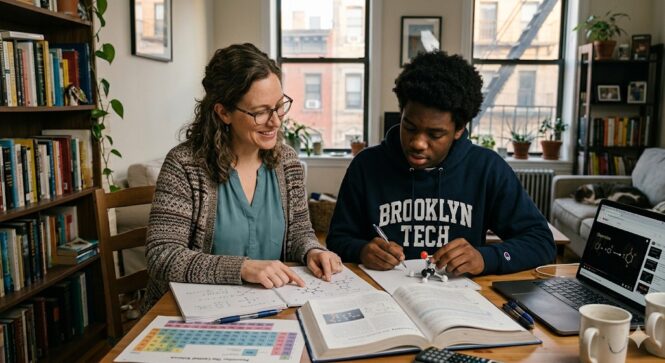
- Chemistry tutoring often begins when coursework becomes conceptually demanding
- Many NYC students seek support during Regents and AP Chemistry preparation
- In-home tutoring aligns instruction with school curriculum
- One-on-one tutoring improves problem-solving consistency
- Structured tutoring supports long-term academic performance
Frequently Asked Questions
1. Which chemistry courses do you support?
Tutor availability may include standard high-school chemistry, Regents-level chemistry, honors chemistry, AP Chemistry, middle-school enrichment, and selected introductory college courses. Matching depends on the curriculum and required expertise.
2. Which New York chemistry Regents examination should my child prepare for?
New York is transitioning from Physical Setting/Chemistry to Physical Science: Chemistry. Families should confirm the student’s assigned examination with the school because the exams use different standards, materials, and reference tables.
3. Can tutors help with laboratory reports?
Tutors can help students understand experimental design, organize data, complete calculations, interpret results, and improve explanations. Students remain responsible for completing their own work.
4. Can tutoring satisfy the laboratory or investigation requirement?
No. Required laboratory experiences and investigations must be completed and documented through the student’s school. Tutoring cannot certify Regents eligibility.
5. Do you provide AP Chemistry tutoring?
Yes, subject to the availability of a tutor with appropriate AP Chemistry expertise. Families can explore our dedicated AP Chemistry tutoring service.
6. Can a chemistry tutor also help with algebra?
Tutors can review algebraic skills used in chemistry when appropriate. Students with substantial mathematics gaps may also benefit from separate math tutoring.
7. Can tutoring guarantee higher grades or a Regents score?
No. Tutoring can provide targeted instruction and structured preparation, but academic and examination results cannot be guaranteed.
8. How much does tutoring cost?
Rates depend on the tutor, course level, and service arrangement. Families can review our current tutoring rates for additional information.
Get Started with Chemistry Tutoring in NYC
The right tutoring arrangement depends on the student’s course, applicable Regents examination, current difficulties, goals, schedule, location, and preferred instructional format. Use our Start Here page to tell us what kind of chemistry support you are seeking. We will review the information and consider available tutors whose subject knowledge, schedule, and delivery format align with the student’s needs.
Not ready to fill out the form yet? We’re here to make this easy.
📞 (917) 382-8641 | 📲 (917) 382-8641 | ✉ info@thembatutors.com
Every coach offers a free 15-minute remote meet-and-greet, so you can get to know them and see if it feels like the right fit. We’re very responsive and easy to communicate with throughout the process. From there, we’ll thoughtfully match you with one or more of our coaches.